Utility-Scale Solar Dominates EIA Database of Large Energy Generation Projects
Data centers. Semiconductor plants. AI. Their need for more electric power and the push for the expansion and revitalization of the U.S. power grid is very much in the national news these days.
It’s become one of the biggest market drivers this industry has ever seen, and the need for more data centers has created what at least one industry veteran says is a once-in-a-career sales opportunity.
This megatrend has not so quietly been pumping up investment in utility infrastructure and is showing up in the new construction spending number published monthly by the U.S. Census Bureau. With $137,928 million in spending through July, private power construction is one of the larger construction segments, and with a +8% YOY increase. Its growth metrics also appear to be some of the healthiest.
Another good source of federal data on the growth of the utility market is the government’s Energy Information Administration (EIA). Each year, it breaks out data on utility construction projects in its EIA-860 Annual Electric Generator database at www.eia.gov.
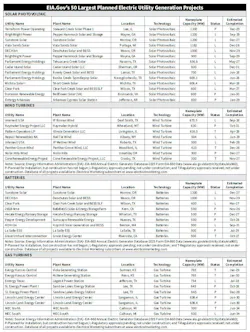
While EIA's current project data is a bit dated because it's tracking projects underway in 2025, the proposed project data is interesting because it shows where the projects are in the approval process and when the projects are expected to go live. The chart on page 2 lists the 50 largest projects now in the proposal or approval stage. It’s interesting to note that six of the 10 power projects being proposed or currently working their way through the approval process are solar, including five expected to each product a gigawatt of power.
While utility-scale solar projects are the most numerous, the sheer size of the largest project being proposed, Fermi Nuclear’s Project Matador in Carson, TX, is mind-blowing. The nuclear reactors are expected to generate roughly 4.5GW of power when completed by 2031. As a point of comparison, New York City uses 4GW to 6GW of power in a single day, according to a Reddit post. In total, Fermi says it plans to scale power production at the site up to 17GW.
The largest proposed solar projects in the EIA database are interesting not only because they are each expected to produce more than 1GW in power but because several of them are also planning to incorporate large on-site BESS (Battery Energy Storage System) facilities to store what they produce. For example, EIA says the Sunstone Solar photovoltaic project planned for Morrow, OR, will have 1.2GW in solar generating capacity and 1.2GW in on-site battery capacity. Amazon Energy acquired the facility in January when the previous owner, Pine Gate Renewables, filed for Chapter 11 bankruptcy, according to a post at www.pv-magazine-usa.com. It’s expected to go live in 4Q 2027.
Another proposed Oregon-based solar project with 1GW in solar generating capacity and 1GW in battery storage is the Deschutes Solar and BESS project in Wasco, OR, targeted for Nov. 2029 completion.
While federal solar incentives have gotten pummeled because of the not-so-green persuasion of the current Administration, don’t sleep on solar. The number of PV projects in the EIA now underway or being planned is impressive.