NEMA Sees Solid Growth in Data Center & Utility Grid Construction Through 2027

In its recent ElectroIndustry Economic Outlook, the National Electrical Manufacturers Association (NEMA) offered some great insight into the opportunities and challenges the electrical market faces in the coming years.
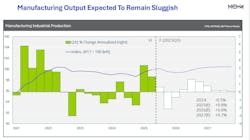
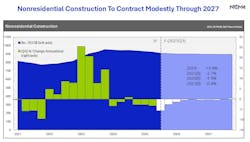
While Don Leavens, NEMA’s senior VP & and chief economist, expects nonresidential construction to contract modestly through 2026 (-1.9%) and 2027 (-0.4%) after a -2.7% decline in 2025, he sees data center and grid construction to continue to be growth markets.
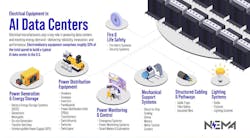
“We’ve developed our own forecasts for data centers building off models and new data that’s been provided publicly,” he said in the Dec. 10 presentation. “And where we saw that strong growth in 2024, we see it leveling off. There’s practical limitations on the supply chain side. We just don’t have enough electricians, enough construction labor and enough available grid connections to continue to grow at the pace that we saw in 2024. But the underlying demand for that growth is still there.”
Leavens said the other supply chain constraint for data center construction is the labor supply. “The hyperscalers have figured out how to get around the grid," he said. “They can generate their own power, at least temporarily, until they can connect to the grid. But the rate-limiting step for many hyperscalers is access to electricians and construction workers.”
Spencer Pederson, NEMA VP of Public Affairs, said the transformer shortages that were such a big concern several years back aren’t as big of an issue. “Certainly, a couple of years ago, the transformer backlogs were worse than they are today. Part of that was because the Department of Energy was going through a new energy efficiency standard for distribution transformers right at the height of when that backlog was getting at its worst, and at a point when the White House had put them on a Defense Production Act order.
“That efficiency standard — which took two years to complete — really slowed investment in new manufacturing. So, what you’ve seen since that efficiency standard was finalized, there’s now some market certainty on what the standard is that we have to manufacture toward, and there’s been a lot more investment in distribution transformer manufacturing since then.
“We’re seeing some of that come online. But I think depending on the type, it could still be as much as a year out for certain transformers. And I would say that switchgear is probably not too far behind that in terms of demand outstripping supply.”
The three panelists on the NEMA panel, Leavens, Pederson & Barry Powell, NEMA vice chair and Siemens’ head of Electrical Products, North America, agreed the U.S. electroindustry will continue to invest in U.S. factories. Since 2018, NEMA said electrical companies have invested $185 billion in their U.S. facilities with $82.1 billion of that total being invested in five states: North Carolina ($18.8 billion); Georgia ($18.4 billion); South Carolina ($18.08 billion); Tennessee ($13.6 billion); and Michigan ($13.3 billion).
Planned domestic capital investment in the electrical manufacturing industry may reach $60 billion over the next five years, according to a Sept. 2025 NEMA survey.