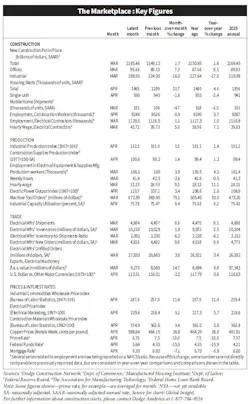
Electrical Market Key Indicators - May 29, 2026 Update

Single-family building permits show some signs of life in April
April building permits were at a seasonally adjusted annual rate of 1,442,000, +5.8% above the revised March rate of 1,363,000, but -0.2% below the April 2025 rate of 1,445,000. Single-family authorizations in April were at a rate of 872,000, -2.6% below the revised March figure of 895,000.
AIA architects’ billings slide slightly in April
Architecture firm billings declined modestly in April as broader economic instability continued. The AIA/Deltek Architecture Billings Index (ABI) fell from 49.8 points in March, when billings were essentially flat, to 48.3 points in April, signaling that more firms reported declining billings than rising billings. Architecture firm billings have remained below the 50-point growth threshold since Jan. 2023.
“April’s economic picture was mixed as employers continued to add jobs, but inflation accelerated as higher energy prices tied to the conflict in Iran drove up costs,” said Richard Branch, AIA chief economist, in the press release. “While a proposed gas tax holiday could offer some short-term relief, energy prices are unlikely to ease meaningfully until the conflict ends.”
Leading indicators slip in April
The Conference Board Leading Economic Index (LEI) for the U.S. rose slightly by +0.1% in April 2026 to 97.4 points, following a 0.6% decline in March. Overall, the LEI fell by -0.7% over the six months between Oct. 2025 and April 2026, a less severe rate of decline than its 1% contraction over the previous six months (April to October 2025).
Justyna Zabinska-La Monica, senior manager, Business Cycle Indicators, The Conference Board, said in the release, “The leading index rose in two of the past three months, but the gains did not offset the steep fall registered in March. As a result, the LEI’s six- and twelve-month growth rates were negative, signaling fragile economic conditions ahead. Strong investment in AI infrastructure, data centers, and energy production likely will have a positive impact on growth and sustain business spending, but may only partially offset weakness on the consumer side.
“Higher gasoline and energy costs — paired with weak hiring — will likely erode household purchasing power in the months ahead, particularly for lower- and middle-income consumers.”