Government Finally Releases Construction Data, But It Doesn’t Paint a Pretty Picture

Now that the government shutdown is over, economic data is starting to trickle in from the U.S. Census Bureau, Dept. of Commerce and Bureau of Labor Statistics.
One of the first batches of data to surface was construction spending through August. Being four months old, this data is a bit stale, but it still provides some insight into construction spending until the government releases more current data.
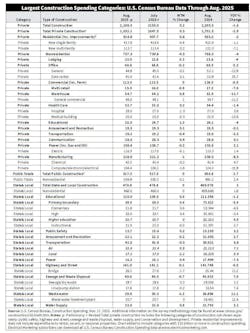
Electrical Marketing always provides the monthly top-line construction spending data, because it offers a quick snapshot of the overall health of the U.S private and public and construction markets (see table below). But the government also provides national data on some individual construction niches within the broader categories in the top-line reports. The good news is that the more detailed data for August spending is now out, but the bad news is that it shows a whole lot of construction niches haven’t grown much over the past year and in many cases are lagging the year-over-year (YOY) performance of total construction spending, down -1.6% year-over-year (YOY) through August to $2,169.5 billion. The biggest chunk of that spending is in private construction, and it’s also down, off -2.9% to $1,652,1 billion.
To no one’s surprise, the construction of private data centers were up the most YOY through August with a +25.7% increase to $41.4 billion. The Census Bureau reports data centers in the Private Office category for some reason, and they are totally dominating that category with 46.7% of all construction spending there.
Two of the other construction niches enjoying double-digit growth over the past year through August were state and local wastewater treatment plants, up +12.4% to $20.7 billion and state and local bridge construction, with a +11.2% increase to $28.3 billion. State and local sewage and waste disposal (+7.9%); and the construction of state and local air facilities (+7.1%) also are on track for respectable increases.
Some of the construction verticals at the negative end of the growth spectrum were private computer/electronic/electrical factories, down -15.9% YOY to $104.4 billion; private warehouses (-11.7%) to $54.7 billion; private medical buildings, -10.8% to $20.4 billion and the overall private manufacturing category (-8.5%) to $218.9 billion.
The sluggish growth or outright decreases in so many of the individual construction market categories in the U.S. Census Department’s construction spending data paint a rather pedestrian picture of the overall level of construction activity, and hopefully when the government releases more current data the numbers will improve.
Click here for U.S. Census Bureau Construction Spending data through Aug. 2025
About the Author

Jim Lucy
Editor-in-Chief
Over the past 40-plus years, hundreds of Jim’s articles have been published in Electrical Wholesaling and Electrical Marketing newsletter on topics such as the impact of new competitors on the electrical market’s channels of distribution, energy-efficient lighting and renewables, and local market economics. In addition to his published work, Jim regularly gives presentations on these topics to C-suite executives, industry groups and investment analysts.
He launched a new subscription-based data product for Electrical Marketing that offers electrical sales potential estimates and related market data for more than 300 metropolitan areas, and in 1999 he published his first book, “The Electrical Marketer’s Survival Guide” for electrical industry executives looking for an overview of key market trends.
While managing Electrical Wholesaling’s editorial operations, Jim and the publication’s staff won several Jesse H. Neal awards for editorial excellence, the highest honor in the business press, and numerous national and regional awards from the American Society of Business Press Editors. He has a master’s degree in Communications and a bachelor’s degree in Journalism from Glassboro State College, Glassboro, N.J. (now Rowan University).